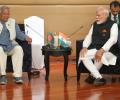
A former Bangladesh army officer and close aide of Chief Adviser Muhammad Yunus has suggested that Dhaka should collaborate with China to occupy India's northeastern states if it attacks Pakistan in response to the Pahalgam terror attack. Bangladesh's interim government has distanced itself from the remarks made by Major General (Retd) ALM Fazlur Rahman on his social media account. Rahman's comments come amidst growing tensions between India and Bangladesh following Yunus' remarks in China about India's northeastern states being landlocked and needing Bangladesh's access to the ocean. These incidents have further strained relations between the two countries, with India withdrawing transhipment facilities granted to Bangladesh for exporting goods to the Middle East, Europe, and various other countries.

External Affairs Minister S Jaishankar on Wednesday took a critical view of some of the key decisions made by the Jawaharlal Nehru government, and said one needs to get out of this "cult worship" that the period from 1946 onwards was "great years" and the country did "splendidly".
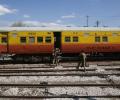
India has strongly rejected Pakistan's allegations of backing terrorism against that country following the Balochistan train attack. India said Islamabad should look inwards before shifting the blame on others for its "failures " and that the whole world knows "where the epicentre of global terrorism lies ". Pakistan, on the other hand, has accused India of "sponsoring terrorism " without directly implicating it in the Balochistan train attack that killed 21 passengers.

World leaders, including US President Donald Trump, Russian President Vladimir Putin and Israeli Prime Minister Benjamin Netanyahu, condemned the terror attack in Jammu and Kashmir that killed 26 people, expressing solidarity with India. The attack was claimed by The Resistance Front (TRF), a proxy of the Pakistan-based Lashkar-e-Taiba (LeT) terrorist group. The attack came during US Vice President J D Vance's maiden visit to India. Prime Minister Modi, who had arrived in Saudi Arabia on a two-day visit earlier in the day, cut short his visit and departed for New Delhi on Tuesday night following the attack.

We have nothing to gain by raising our concerns internationally as our narrative has got entangled with several controversial concepts in the United Nations, asserts Ambassador T N Sreenivasan.

Since October, FPIs have offloaded Indian equities worth Rs 2.1 trillion.
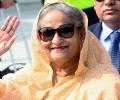
The Anti-Discrimination Student Movement (SAD), which led protests against Bangladesh Prime Minister Sheikh Hasina, has launched itself as a political party called the National Citizen Party (NCP). The new party, which aims to 'dismantle constitutional autocracy' and establish a 'second republic,' has pledged to create a 'solely Bangladesh-oriented' political system, with no room for 'pro-India and pro-Pakistan politics.' The NCP's inaugural rally was attended by representatives of various political parties, including the Bangladesh Nationalist Party (BNP), Jamaat-e-Islami, and envoys from the Vatican and Pakistan.

From the Sensex firms, Eternal, Mahindra & Mahindra, Maruti, Bajaj Finance, Tata Steel, Bharti Airtel, Bajaj Finserv, Asian Paints, Power Grid and State Bank of India were among the laggards. Kotak Mahindra Bank, Axis Bank, Titan, HCL Tech, Tata Motors, Infosys and Tata Consultancy Services were the gainers.
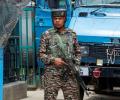
S&P Global Ratings on Thursday said the hostilities between India and Pakistan heighten risks to the credit metrics of both countries, and any escalation in clashes would put downward pressure on sovereign credit support.
Global funds have pulled out Rs 1.54 trillion from domestic stocks in fiscal 2024 - 25 (FY25), the highest-ever outflow recorded so far, according to the data compiled by Business Standard. The last time the global funds exited Indian shores in droves was back in 2022, when they sold a net Rs 1.41 in the backdrop of Covid-19.

Prime Minister Narendra Modi and US Vice President JD Vance have expressed satisfaction with the progress made in negotiations for a bilateral trade agreement. The two leaders met in New Delhi and discussed a range of bilateral issues, including cooperation in energy, defense, strategic technologies, and other areas. They also exchanged views on regional and global issues of mutual interest.
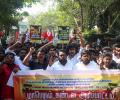
Tamil Nadu Chief Minister M K Stalin has reiterated the state's opposition to Hindi imposition by the Centre, calling it a 'mask' for Sanskrit. He also claimed that the National Education Policy (NEP) is being used to promote Sanskrit in many states, and that the Centre is trying to do away with languages like Tamil and impose Sanskrit. Stalin's statement comes amid growing concerns over the alleged imposition of Hindi in non-Hindi speaking states.

The pace of loan growth among public sector banks (PSBs) has seen a surge in the financial year 2024-25, and this is an exception to the overall moderation in bank credit during FY25. PSU banks' share in incremental credit rose to 57.3 per cent in March from 51.7 per cent a year ago, according to the Reserve Bank of India's (RBI's) Monetary Policy Report (April 2025).

President Donald Trump is expected to sign a series of executive orders fulfilling campaign promises, including declaring an emergency at the southern border, addressing a national energy crisis, and defining sex-related policies. The orders aim to address immigration, national security, and energy independence, with a focus on reversing policies implemented by the previous administration.

China appears determined to upgrade Pakistan's military capabilities, sufficient to ensure local parity with India, alerts former foreign secretary Ambassador Shyam Saran.
The ministry of home affairs has suspended the Foreign Contribution Regulation Act (FCRA) licence of prominent public think-tank Centre for Policy Research (CPR) over violation of laws, officials said on Thursday.

Escalating trade tensions amid a tariff war after Donald Trump took over as President of the United States (US) could adversely impact global growth and fuel inflation, an article on the "State of the Economy" in the Reserve Bank of India (RBI) monthly bulletin said.
Among Sensex scrips, Bharti Airtel, Titan, NTPC, State Bank of India, ITC, Tata Steel, Mahindra & Mahindra and Tata Motors were the major laggards. Adani Ports, Infosys, Axis Bank, HCL Technologies, Tech Mahindra and IndusInd Bank were among the gainers.

While India has become the largest data generating nation, and hosts more than 152 data centres, it is fed by only 18 undersea cables.
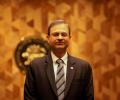
Since Sanjay Malhotra took office as governor in December, the Reserve Bank of India (RBI) has adopted a more accommodative stance, which bodes well for banking and the economy as they navigate a growth slowdown, according to analysts.
The government may roll out a new foreign trade policy (FTP) of a shorter term of two-three years in a bid to keep pace with the fast-evolving scenarios in international trade which have been triggered by recent disruptions, such as the pandemic and the Russia-Ukraine war. An FTP is an elaborate policy guideline and strategy to promote the export of goods and services, with a duration of five years usually. The existing policy came into force on April 1, 2015, and was valid for five years, before multiple extensions.

India has extended duty-free imports of urad for another year until March 31, 2026, according to a government notification. The provision was earlier in place until the end of March this year.
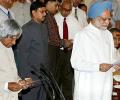
The landmark India-US civil nuclear deal of 2008, brokered during Manmohan Singh's tenure as Prime Minister, is seen as a crowning achievement in his foreign policy legacy. The agreement ended India's nuclear isolation, fostered a strategic partnership with the US, and opened doors to advanced technologies and defense cooperation. This historic deal also laid the groundwork for India's engagement with the global nuclear community.

Prime Minister Narendra Modi officially commissioned the Vizhinjam International Seaport on Friday in Thiruvananthapuram in the presence of Chief Minister Pinarayi Vijayan and senior Congress leader Shashi Tharoor, whose presence at the inauguration, Modi said, will give 'sleepless nights' to many.

With India's EV penetration at just 2.5 per cent, the market presents an opportunity -- provided Tesla gets its pricing right.

Equity markets will take cues from the US tariff related developments, global trends and trading activity of foreign investors this week, analysts said.

The US Fed interest rate decision, global trends, tariff-related developments and trading activity of foreign investors will drive the equity market movement this week, analysts said. Among macroeconomic data announcement, WPI inflation for February is scheduled to be announced on Monday.

The equity benchmark indices posted their strongest weekly gains in years, driven by bargain hunting and optimism over a reversal in foreign portfolio investor (FPI) outflows. The Sensex rose 558 points, or 0.7 per cent, on Friday to close at 76,906, while the Nifty 50 gained 160 points to end at 23,350. Over the past five sessions, both indices advanced around 4.3 per cent - marking the Sensex's best weekly performance since July 22, 2022, and the Nifty 50's strongest rally since February 5, 2021.
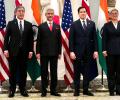
Soon after he was sworn in by Vice President J D Vance, US Secretary of State Marco Rubio hosted External Affairs Minister S Jaishankar, Penny Wong from Australia and Japan's Iwaya Takeshi for his first multilateral meeting as the top American diplomat.
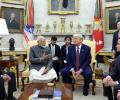
'By his words, actions, and body language during their joint press appearance wanted to convey his personal respect and, more broadly, his desire to work closely with India.'

The US Fed rate cut of 50 basis points is unlikely to have any significant impact on foreign inflows into India, Economic Affairs Secretary Ajay Seth said on Thursday. He said the US Federal Reserve has done what it assesses is good for the largest economy in the world, but the RBI will take a decision on interest rate cut keeping the Indian economy in mind. "It is a positive for the global economy, including the Indian economy. "It is a 50 basis points cut from a high level.

One hopes the new Lok Sabha will mark a break from a dismal tradition -- lack of interest in defence and security policies, argues Colonel Anil A Athale.
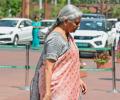
The resilience of the economy and strength of domestic demand will continue to make India an engine of growth amid the rapidly evolving global trade landscape as a result of US tariffs, Finance Minister Nirmala Sitharaman said in London on Tuesday.

The Budget should undertake further reductions in import tariffs and seriously consider an announcement of India's intention to join one or both of the two Asian mega-regional free trade agreements, suggests Shankar Acharya, former chief economic adviser to the Government of India.
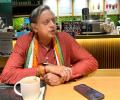
'When I stepped down from the (United Nations) secretary general's race, the first visitor I had was a former minister of the Vajpayee government inviting me to the join the BJP.'

In an eventful week ahead, stock markets may face volatile trends before the RBI's interest rate decision and the US inflation data announcements, as investors continue to assess the broader implications of US tariffs on global economy and inflation, analysts said. Investors fear that a full-blown trade war will impact global trade and economic growth, according to market experts.

Equity benchmark indices are facing massive corrections, with the NSE Nifty declining over 14 per cent from its lifetime high hit in September last year due to several negative triggers like stretched valuations, foreign fund exodus, disappointing quarterly earnings and rising global trade tensions dragging markets lower. The BSE benchmark Sensex hit its record peak of 85,978.25 on September 27 last year, and the Nifty also reached a lifetime high of 26,277.35 on the same day.

Calm prevailed in Punjab, especially in the border areas of the state, on Sunday morning, following an understanding between India and Pakistan to stop all firings and military actions on land, air and sea.
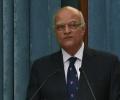
Former National Security Advisor (NSA) Shivshankar Menon has stated that the political dynamics between India and Pakistan have resulted in a "controlled level of hostility" that benefits the ruling elites in both nations. Speaking at the Kerala Literature Festival, Menon described Pakistan as a "brand new state" still grappling with its national identity. He argued that India's foreign policy towards Pakistan is influenced by its domestic politics, resulting in an uneasy equilibrium characterized by a "controlled level of hostility." Menon also questioned the concept of a multipolar world, stating that the current global order is merely "confused." He emphasized that the United States remains the world's true military hegemon, while other nations, including China, are regional powers. Menon further argued that there is no binding international order, leading to a state of "between orders." He highlighted the absence of definitive international agreements on crucial issues in recent decades.

From the Sensex pack, UltraTech Cement, Infosys, Bajaj Finserv, Axis Bank, HDFC Bank, Bharti Airtel, HCL Tech and Tata Consultancy Services were the biggest gainers. Zomato tanked nearly 6 per cent followed by IndusInd Bank which declined about 5 per cent. Adani Ports, Mahindra & Mahindra, Reliance Industries and Sun Pharma were also among the laggards.
 © 2026 Rediff.com - Advertise with us - Disclaimer - Privacy Policy - Sitemap - Feedback - About us - Terms of use - Grievances